Showing posts with label intoxicating plants. Show all posts

Wednesday, June 26, 2019

Cycads

Image result for cycad free stock photo

It may look like a baby palm tree, but it is not. In areas where it grows, it has even been used instead of palm fronds on Palm Sunday. But a palm is a flowering plant, and cycads are gymnosperms, which are related to pines and do not flower. However, they do have seeds and pollen, and some species in this group may have been among the first plants pollinated by insects.  And, in regards to pollen, the pollen of some cycads has been used as a narcotic.

The group is old, and lived at the same time that butterflies were coming into existence and dinosaurs were dying out. Maybe the long lost cousins of this plant were eaten by a stegosaurus.

Cycads grow around the world, mostly in the southern hemisphere, although they are found naturally in Florida and Mexico. They are also native in South America, India, Africa, and Australia.

They also grow in the Philippines and in Guam, east of the Philippines. In those areas, as in many others, the starchy parts of the plant are used for food after the toxins are carefully leached out.

This worked well, and few people got sick. However, mysteriously, many people started to get sick in the 1940s. At the time, they didn't know the cause. But after some sleuthing, it was traced back to the cycads.


During traditional feasts, the native Chamorro men ate bats boiled in milk. THE WHOLE THING: fur, bones, guts, all of it. They had done this for hundreds or maybe even thousands of years. However, during WWII, a military base was established on Guam, which brought guns to a culture that had never had them before. As a result, they could kill more bats and eat more bats. It turns out that the bats were feasting on cycads, and accumulating the toxins in their body. Then when the men ate the bats, they ingested a super sized dose and got sick.

Thankfully, as the Chamorro started eating fewer bats, the incidence of the disease decreased.

(intoxicating plants)  (sacred plant)


Thursday, May 12, 2016

Tobacco

We think of tobacco as a horrible habit. But at one time it was a sacred plant. Almost all tribes in North America and most tribes in South America used it. It was smoked during rituals, ceremonies and social events.  It was used to connect the worlds because the it has long deep roots underground, a green plant on the surface of the earth, fire that represented the sun, and smoke that rises skyward. It was put in a fire in a sweat lodge to thank the creator.  It can be smoked during prayer to take messages to the creator and to those who have died. It was also used medicinally for stomach aches and fever.

The UC Bot Garden was very interested in tobacco circa 1920-1940. Probably mostly from a financial point of view. William Setchell (director from 1902-1928) collected pipes in San Francisco. Thomas Goodspeed (director from 1928-1954) made many trips to South America collecting a variety of Nicotiana species. The idea was to improve on the commercial tobacco with hybridization. I'm not sure which one enjoyed their field trips more.

In bloom now in the crop garden at the UC Botanical Garden.


"Nicotine acts to increase the production of other chemicals in the brain known as neurotransmitters that affect brain function. ... Nicotine also produces long-term effects on the dopamine system, which is involved in reward, mood and addiction." 

This quote is stolen from the web. 

(intoxicating plants)

Tuesday, October 12, 2010

Palms


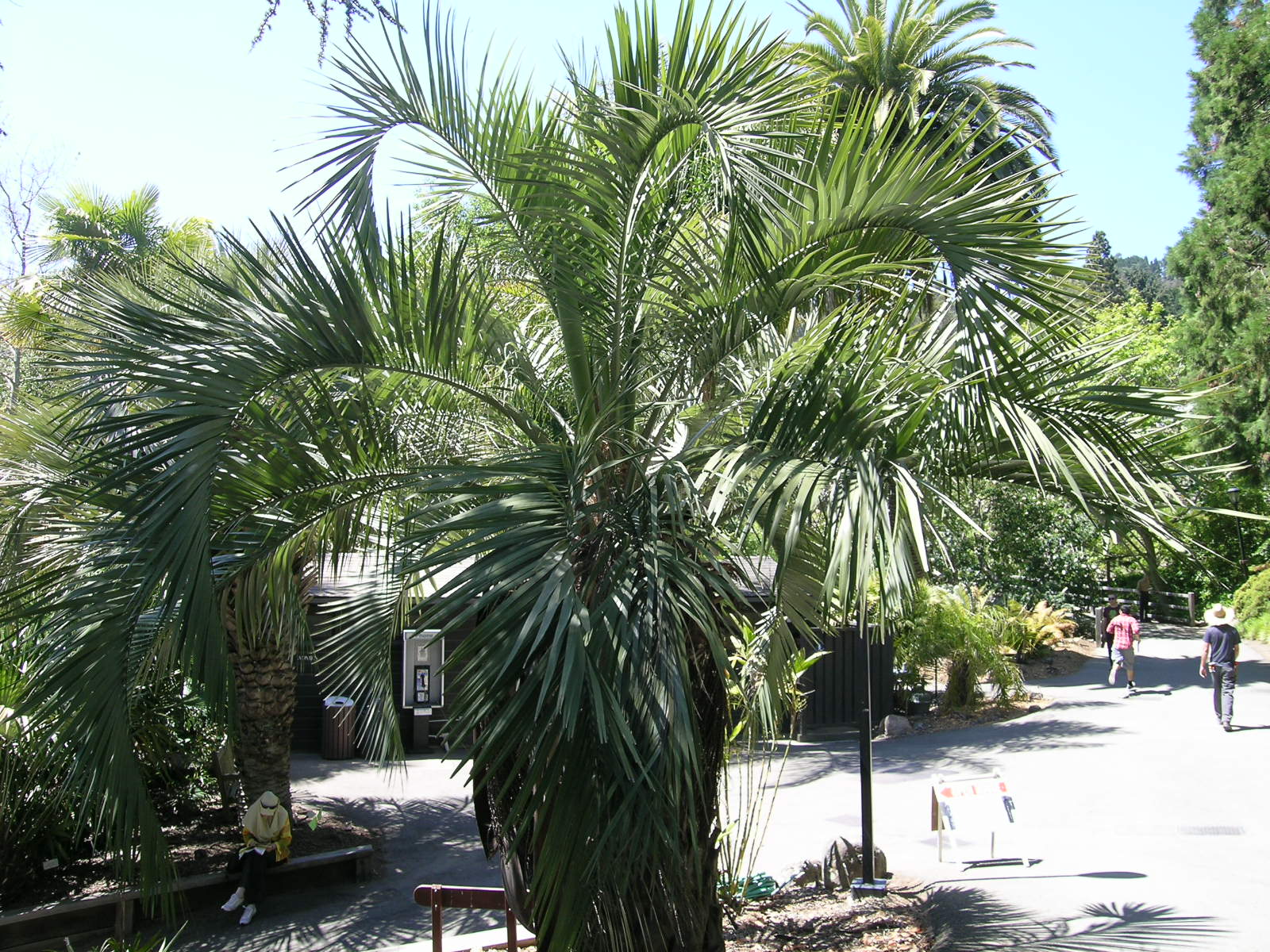
Is a palm tree a tree? How do you define a tree? Some people think that if it is taller than they are, it must be a tree. Others think that if it doesn't branch, it isn't a tree. Whether the palm is a tree or not, it is a rather odd monocot, more closely related to grasses and lilies than to oaks and cherries.

Humans have used palms since forever! In the middle east, date palms were cultivated 5,000 years ago. These plants have been used for food, but they also provide many other products: rattan cane, raffia, carnauba wax and oil.

Coconut palms provide us with fruit used to make macaroons and coconut milk. In addition, palm wine can be made from the sap of this tree. To get the sap, a flower bunch is removed and a bucket is placed under the remaining stump. Because of yeast in the air, you can have wine within two hours! Wow!

It is a bit more difficult to get sap from a Chilean Wine Palm. The tree has to be cut down, and the top is pointed downhill. The leaves are removed to get the sap to flow from the trunk. To keep the sap flowing, razor thin layers are removed from the trunk every day. This worked fine for the indigenous peoples, but when the conquistadors arrived, they were greedy and destroyed whole forests. Now it is an endangered species. The good news is that this large, wide trunked palm loves bay area weather. Maybe you would like to plant one. Palms work especially well near a pool where you want a tropical look but don't want leaves clogging up the filter.


(intoxicating plant)

Monday, October 11, 2010

Opuntia phaeacantha--Prickly Pear--Cactaceae


Cochineal is a a scale insect that eats only Opuntia. It also produces a red dye that is designed to deter predators. Humans, however use red dye to color their world. The Maya and Aztec peoples used it for thousands of years. When the Spanish arrived in the 15th century, they were bewitched by the deep red color and it became a big export. Cochineal was used the color the red stripes on the US flag and the red coats of the British army. More recently, cochineal was used to make McDonald's milkshakes look pink and Compari look red. Some companies like to use insect dyes because they are natural. But more people are allergic to cochineal than to coal tar dyes. So many companies use artificial dyes.

Opuntia can be used to get drunk. The fruits, or tunas, can be used to flavor cactus margaritas. They can also be used to cure a hangover. An extract from the pads, or nopales, inhibits the production of inflammatory mediators, which in turn reduces the symptoms such as dry mouth, nausea and lack of appetite. You can even buy capsules!

Prickly Pear Nopal Cactus (Opuntia ficus-indica), 650 mg, 180 Capsules, 2 Bottles


Some species may also be useful in treating diabetes.

Opuntia species are native to the new world from Canada to South America. One species is endangered in Florida, another is an invasive exotic in Australia. The cactus moth, Cactoblastis cactorum, has been used to control Opuntia in Australia. The same moth is considered a threat to Opuntia species in Florida and Mexico.

At the UC Botanical Garden, there are several species of Opuntia, some in the New World Desert, some in the California section. I didn't see any in bloom today, but some of the fruits are ripening.


(intoxicating plants) (Insects)

Rhododendron kiusianum section tsutsusi


The nectar of rhododendrons is toxic. Somehow the bees can deal with it, but the humans cannot. In 401 BC, Greek soldiers ate honey from wild hives near the black sea and became sick for several days. That was just an accident. But an event in 67 BC was more like chemical warfare. Pompey's Roman armies were tempted by the same kind of honey in the same area, but this time the honey was deliberately placed by the enemy (Persians). Pompey's soldiers were so sick that they were easily killed. In 946 AD, the foes of Olga of Kieve were defeated by mead made from toxic honey.

Toxic honey has also been used in religious ritual. If you eat just a little, you hallucinate instead of getting really sick. In the 7th century BC, bee priestesses or "Melissae" revealed the future under the influence of maddening honey according to the Greek poet Homer. They ate "meli chloron" or green honey to put them in a spiritual frenzy and inspire their prophecies. Was it just toxic honey, mead made from toxic honey, or mead spiked with toxic honey? No one knows for sure.

In the 18th century, toxic honey, or "miel fou" was shipped from Turkey to European taverns where it was mixed with Ale to give it an extra kick. I guess it is no longer available, though. I couldn't find any rhodie honey on Goggle shopping. [Edit June 2019: Rhodie honey now available on the internet.]  (Sacred Plant)

I don't really think of this as Rhododendron season, this R. kiusianum is in full bloom now at the UC Botanical Garden. 

(intoxicating plant) (Human/Insect/Plant triad) (Sacred Plant) (insect)

Sunday, October 10, 2010

Artemisia absinthium--Wormwood--Asteraceae


Imagine France during the Bell Epoque. In the nightclubs, one stylish drink was absinthe. The ritual was important. The clear green liquor is poured into the bulb at the bottom of a stemmed glass. A flat sugar spoon is laid across the top of the glass. The water is poured over the sugar and into the glass. As the water hits the absinthe, it changes from clear green to cloudy and the green fairy is released. Absinthe has the flavor of Liquorice, but the famous ingredient is wormwood, which contains thujone, a neurotoxin. It was thought that it was thujone that caused absinthe drinkers to hallucinate and become delirious. But really, no one know what it actually was. At any rate, people blame absinthe for the sinister quality of Edgar Allen Poe's short stories. Perhaps it was the absinthe that caused Vincent Van Gogh to cut off his ear. And the poet Paul Veraine binged on absinthe before setting his wife's hair on fire. Recent research indicates that absinthe had little thujone and that it could not have caused the problems. Some believe that the spirit was adulterated with copper sulfate, a pesticide, or copper acetate, because it was cheaper to create the green color that way, and perhaps the copper caused people to go crazy. Perhaps it was more of a political thing. Maybe the politicians wanted to ban absinthe because it was a big part of the counterculture. Or maybe the wine makers wanted to sell more wine. Anyway, it was banned for many years, but it now legal again.


(intoxicating plant)

Humulus lupulus--Common Hop--Cannabaceae


Humulus lupulus is native to Europe, but other species are native to North America, South America, and Asia. Hop is in the same family as marijuana, and like marijuana, it is psychoactive, just not so strong. It makes people feel sleepy and relaxed. Seems like it is a good thing to add to alcohol, because alcohol can sometimes cause people to become violent. Beer is just better!

The hops adds flavor to beer and adds a calming element to the drink. It is also a preservative and keeps the beer from going bad. Even a beer with a low alcohol content can keep for a long time if it is flavored with hops.

Hop is a vine, hops are the female flower clusters used to flavor beer for thousands of years. Currently, crops are grown in Asia, Australia, Europe and the western US. The flowers are dried before being used in brewing.

Mostly hops are used in beer. But they are also used in soft drinks in Sweden and Latin America. A hops pillow is sometimes used for insomnia since hops can make people feel sleepy and relaxed. It is used in some deodorants to kill bacteria. And the dried flowers are decorative and can be used in a bouquet or wreath.

The young shoots of the hop plant can be eaten as a vegetable. The spears are eaten much like asparagus. If you want to grow hops or use hops, just look online. Many different products are available.

Beer was first made thousands of years ago, and the use of hops is hundreds of years old. It is a product of enduring appeal.

(intoxicating plants)

Friday, October 8, 2010

Saccharum sp--Sugar Cane--Poaceae


At the back of the Tropical House at the UC Botanical Garden grows a small bunch of sugar cane. That grassy stuff in the pic may look 2' tall, but it actually is 20'. It gets really big. This grass is native to Indonesia, and Christopher Columbus introduced it to the Caribbean. The climate there was perfect, and it grew well. Eventually, plantations were established. At first, it was the sugar that the Europeans wanted. The cane was harvested and crushed. Then then juice was boiled to reduce water content and produce sugar. After the crystals were extracted, molasses was left. The molasses was considered a waste product until people realized that it was fermenting in the sun and a new alcoholic drink was born: rum. Rum was very popular with the British Navy, because it was cheaper to produce than brandy, the previous favorite. They couldn't put water on the ships, it went bad too quickly. So they drank alcohol instead.

At the same time that sugar cane plantations were being planted, the Spanish were taking gold and silver from the new world to Spain. The pirates intercepted the ships to steal the gold and silver, and sometimes food and drink. The pirates also drank rum, but they didn't limit the
quantities the way the British Navy did, so they used the rum as a way to recruit new people.

Sugar was part of the triangle of trade that was going on during the US colonial period. The sugar was shipped to England, along with tobacco and cocoa. There, they sold the sugar and bought manufactured goods. The manufactured goods were taken to Africa and traded for slaves. The slaves were taken to the Caribbean to work on the plantations. The shippers made money at every stop.

(intoxicating plants)

Thursday, October 7, 2010

Juniperus horizontalis--Juniper--Cupressaceae


Remember the movie, Casablanca? "Of all the gin joints in all the world, she had to walk into mine."? That was Humphrey Bogart speaking of Ingrid Bergman. "And you must remember this: a kiss is just a kiss, a smile is just a smile." What a song!

Anyway, gin is usually made from fermented wheat or rye, which is distilled and then flavored with juniper berries and other herbs and spices. Originally, the juniper berries were used because they were believed to have medicinal properties. American Indians used them as a diuretic, and to treat stomach aches and colds. In ancient Greece, they were used to increase physical stamina. I guess they thought it worked like steroids! They were also used to treat rheumatism and arthritis. Some websites say it suppresses the appetite, some say it stimulates appetite. Scientists in Britain have found that it reduces blood sugar and can be used to treat diabetes. Juniper is a conifer, and its berries are the only conifers parts that are used for flavor. Juniper berries are also used to flavor meats and vegetables.

Gin was popular during the prohibition because no aging was necessary. If you are trying to hide production, you don't want casks sitting around in a huge warehouse. So why was it called bathtub gin? Seems like everyone thinks it was because it was made in bathtubs. I used to think that, too. But no. It was because it was put into tall bottles, that needed to be topped off with water, and they wouldn't fit under the sink faucet, so they topped them off in the tub. Live and learn!

(intoxicating plants)

Wednesday, October 6, 2010

Agave tequilana cv Limeno--Agavaceae


Tucked away between the office and the arid house at the UC Botanical Garden is this variegated form of the agave used to make tequila. The alcohol is handmade by people who have tended the plants for generations. They have to know when the sugar content has peaked; at that moment, the plant is removed from the ground and all the leaves are removed from the plant. The core that is left (which weighs about 100 pounds. The plant in the garden is a baby!) is shredded and fermented. The alcohol produced is then distilled and aged to create Tequila. The workers who tend the plants also have to know how to harvest the pups without damaging the plants. The pups are then replanted and grown for about 10 years to attain adequate size for harvest.

Ever wonder about the worm at the bottom of the bottle? That is a marketing scheme created in the 1940s to get people to drink more tequila. Men seem to need to get drunk to consume the worm. And they need to consume to worm to prove how big and strong they are. So worms lead to more tequila sales. Great trick, huh?


(intoxicating plants)