Showing posts with label host plant. Show all posts

Wednesday, April 29, 2020

Grass Skippers


I have Ehrharta growing in my backyard. It is a very common weed. It was brought to the UC Berkeley campus on the shoes of researchers, and has spread everywhere. Including my yard. The Grass Skippers love it. They lay their eggs on the underside of the leaves. 

The eggs are white and pretty easy to find. The caterpillars sew themselves into a leafy tube. I think the Ehrharta makes this easy to do because the blades are soft and wide. They are not much fun to raise because the caterpillars are generally hiding. But it is not that hard. 

Grass skippers are kind of brownish/orangeish butterflies. People ask me, "Are those butterflies?" Maybe because they are not showy. Yes, they are butterflies. Most day-flying lepidoptera are butterflies. They also ask, "What are those butterflies with four wings?" This really confused me at first. All butterflies have four wings, but given the way they hold them, I guess people think they have two. When skippers land, they look different. They often hold their wings in four separate planes so that you can see them clearly. So, the butterflies "with four wings" are skippers. 

Ehrharta

There are other skippers, like the common checkered skipper. It is gray and white. It doesn't hold its wings in four separate planes. And it lays its eggs on mallows. Completely different from grass skippers. 

Umber Skipper

And there are several different grass skippers in this area. Fiery and Umber are the most common. And they are difficult to tell apart, so I don't even try. I don't understand why the spellings are 
F-I-R-E and F-I-E-R-Y. They are both all about fire. Weird!

Ehrharta

And I don't understand the spelling of Ehrharta either. It sounds more like "air harta." Must not be derived from English. 

Grass Skippers do use other grasses, like Bermuda Grass and St Augustine Grass. And they must use some kind of natives. But I unusually see them on flowers or Erharta. They love Ehrharta! It is a great host plant. If you are planting a butterfly garden, leave some grasses at the edge of a lawn to grow tall and go to seed. This creates habitat for the skippers, and lets them complete their lifecycle on the hostplant. 

Saturday, April 25, 2020

Gulf Fritillary and Passion Vine


Gulf Fritillaries are my favorite butterfly to raise. Their eggs are big and orange and easy to see on the green foliage. They have few parasites and diseases. It is easy to keep their host plant (passion vine) fresh. And the adults generally emerge in good time, unlike Anise Swallowtails, which overwinter as chrysalides. 

Passion Vine is also easy to grow. Sometimes too easy. It can take over your whole garden! Gulf Fritillaries like Passiflora caerulea, a rampant grower. But they also like Lavender Lady, which is more delicate and easy to control. Passiflora Berkeley is also a favorite, but harder to find. 


Neither the vine nor the butterfly is a native. The vine (from south of the border) has been planted as an ornamental and the butterfly has followed it north. It has become a resident as far north as Sacramento and Santa Rosa. 

This is one butterfly that you are more likely to see in urban areas. That is where people plant passion vine, and it doesn't seem to escape from gardens. In many cases, the vine flowers profusely, but the fruit is sterile. When I check the fruits of my P. Berkeley, they are empty. 

Passion Vines are highly recommended hostplants for a butterfly garden within the range of the Gulf Fritillary. One of the reasons I love this butterfly is that it hangs around all day, making your garden look like a butterfly garden. Many butterflies, such as Anise Swallowtails, lay a few eggs and fly off. They are beautiful, but they seem to spend most of their time looking for their next fennel plant. 

I appreciate all the butterflies, but the Gulf Frit is a real winner!

Friday, April 17, 2020

Common Checkered Skipper and Mallows

Common Checkered Skippers have many hostplants, all mallows. The one pictured here is a common weed Malva parviflora. They also use Malva neglecta and hollyhocks. They are very cagey about how they use the plant. Whereas Ladies create a web encrusted in frass on the surface of the leaf ( which makes them obvious but unappetizing) the Checkered Skipper folds back a section of the leaf and sews the fold closed. You would never notice the section was missing! They are completely hidden! Clever!


Anise Swallowtail and Fennel

I have raised too many Anise Swallowtails to count. They are easy to find and easy to raise. The problem is the overwintering. They overwinter as a chrysalis. And sometimes for more than one winter. I had one that finally emerged 7 years later. Wow! Supposedly it is so they spread out their emergence, so at least some of them become adults when there is plenty of rain and plenty of host plant.
Their most common hostplant in urban environments is fennel. It was imported by the missionaries as a food plant, and it is edible. Before they showed up, Anise Swallowtails used Perideridia and Lomation. Also poison hemlock and cow parsnip. But their native host plants were eliminated, and they learned to use fennel. Clever!


Monday, April 13, 2020

Nasturtiums and Cabbage Whites


Nasturtiums are one of the host plants for Cabbage Whites. Of course, Cabbage Whites also use cabbages and other plants in the cabbage family. But nasturtiums are everywhere and commonly used.

Cabbage Whites are not the charismatic butterfly. They are so plain in coloration, that people think they are moths. But, like most day-flying lepidoptera, they are butterflies. And they are not native. They were brought to this country from Europe, probably as eggs and larvae on cabbages.

However, I love them. Partly because they are so easy to rear. And partly because they are common across the USA. You can attract them almost anywhere. Put a pot of nasturtiums on your balcony in the middle of a big city, and you will probably get cabbage whites. The caterpillars are so well camouflaged, it is almost impossible to find them on leaves. I find it easier to look for the eggs, since the white eggs contrast nicely with the green leaves.

So even if Cabbage Whites are not the most beautiful or the most loved, they do have their positive qualities.

Saturday, April 11, 2020

Holly-Leaf Cherry and Pale Swallowtails

Pale Swallowtails lay eggs on several different plants, including ash trees and coffee berry. But holly-leaf cherry is an especial favorite of mine, partly because I have actually gotten eggs on my small tree, and was able to raise them. And partly because it is simple a great plant.

There are two very closely related species, Prunus illicifolia and Prunus lyonii. Or maybe one is a subspecies of the other. One has redder fruits, and the other blacker fruits. And I think it makes little difference. The butterflies like them both, and they have similar habits. They both make fabulous evergreen hedges or small trees. In fact, I think they are great substitutes for a Eugenia hedge, which tends to get bubbly leaves from psyllids. Eugenia gets to be about 20' high, and Prunus about 30', but they can both be kept lower.

Pale Swallowtails are not the most common swallowtail around. Perhaps that is because their host plants are not planted that frequently. Perhaps if if you plant Prunus, they will come.

Tuesday, April 7, 2020

Ceanothus and California Tortoiseshell


The California Tortoiseshell lays its eggs on Ceanothus. But only special kinds of Ceanothus. It likes the varieties with large leaves, like the one pictured here. I guess the smaller leaves don't offer enough foliage to eat. 

e 

The California Tortoiseshell has an interesting migration pattern. It likes to lay eggs on blooming Ceanothus. So, I see the adults in Berkeley in about March. But by the time the next generation emerges as adults, the ceanothus in Berkeley is generally done blooming, so the butterflies migrate east or north, looking for fresh blooms. The generations continue to higher elevations and higher latitudes, but return to Berkeley for the Ceanothus that blooms in the subsequent March.

Ceanothus is also the host plant for the Ceanothus Silk Moth, a large and beautiful moth. Although it is called the Ceanothus Silk Moth, it lays its eggs on a wide range of plants, including willow, ribes, and manzanita. It is largely a west coast species, ranging from Baja Mexico to California, Oregon, Washington, and into Canada. The adults do not feeds. I guess they put all their energy into reproduction.

Thursday, April 2, 2020

White Clover

White Clover (aka Trifolium repens) is a common lawn weed in the San Francisco Bay Area. Some people don't like it in their lawn because it can attract bees. Then, if you walk barefoot in the lawn, you can get stung. However, it is hardy, doesn't seem to need much mowing, and adds nitrogen to the soil. So, as with any plant, there are pros and cons.

However, I think it is a great plant to have because it is a host plant for Orange Sulphur butterflies. I rarely see them in flatlands Berkeley, but they are in the area, so I do recommend adding white clover to your lawn or butterfly meadow.

Kenilworth Ivy

People are always concerned when I talk about Kenilworth Ivy. They think it will overtake their garden, like ivy. But it really isn't like ivy at all. Kenilworth ivy is small, delicate, and likes shade. It is also a host plant for Buckeye butterflies. It loves growing in the cracks of steps and walls. And it is absolutely charming!
The Latin name is Cymbalaria muralis. I guess the leaves are supposed to look like cymbals. Must be some kind of cymbal that I have never seen!

Monday, March 30, 2020

Thistles

Having thistle in your garden can be work. Nobody wants to deal with a plant that can poke you, even through gloves. So I rarely see it around the neighborhood. But this patch is not far from my home. It is a favored host plant for Painted Lady butterflies, and Mylitta Crescents also use it. I remember being surprised to see a Mylitta Crescent in my back yard late one summer a few years ago. But I guess there is thistle in the neighborhood to support them. Another weed to appreciate.


Monday, March 23, 2020

Plantain and Buckeye Butterflies


When I mention plantain, people tend to think of the grocery store plantains, which look like bananas but are not as sweet. But when I am talking about butterfly host plants, I am referring to Plantago lanceolata, the common lawn weed. It grows easily in the Berkeley climate, and is a nice addition to a butterfly meadow, especially if you mow infrequently. 


The butterflies seems to lay the eggs near the base of the leaf. They are difficult to collect without pulling up the whole plant. Then I never see the caterpillars feed during the day. I guess they hide in the soil during the day, and come out at night. The caterpillars have their own special beauty; they are adorned with electric blue dots at the base of the spines, which are very difficult to photograph. 

It is well worth the trouble to rear buckeyes. The caterpillars are so beautiful. But the adult! When you see it flying by, it looks like a boring brown butterfly. But up close, the colors are amazing! 

So please, don't think of Plantago lanceolata as a weed. Think of it as habitat. 

Monday, February 10, 2020

Hops and Red Admirals


                                               Red Admiral

Image result for red admiral butterfly


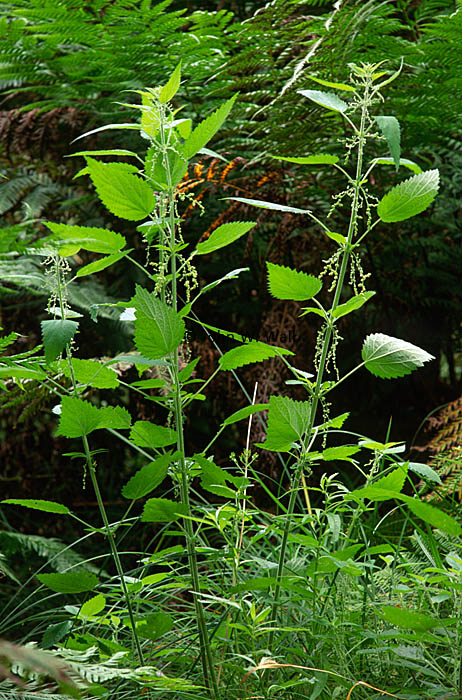
Before Europeans arrived on the scene, red admiral butterflies used stinging nettle, as pictured below.


Most stinging nettle has been removed. Although it is supposed to have healing properties, people don't like being stung, so they get rid of it. Now Red Admirals are more likely to use a common weed, pellitory, pictured below. Or hops, the picture below the stinking nettle. (host plant)

Image result for pellitory


Image result for hops

Wednesday, March 19, 2014

Anise Swallowtail Eggs

I saw my first Anise Swallowtail of the season yesterday. It was fluttering around some fennel. When I looked more closely, sure enough, she had laid some eggs. The white dots on the foliage in the pic are eggs.


(host plant)

Sunday, March 31, 2013

Spring


Yesterday afternoon, it was sunny enough that the butterflies came out. I captured a picture of an Anise Swallowtail laying eggs in my fennel. And a Cabbage White was in the nasturtium; I think it was sunning, not laying.

Yesterday morning I noticed a neighbor out gardening. I complimented her on her beautiful purple lupine. Turns out that that species is a host plant for the Mission Blue. So we started talking about butterflies and she told me about a Monarch hovering around her Family Jewels. I went over to take a look at the plant, and sure enough, it had eggs on it. She said I was welcome to take specimens, especially since she had stumped it back and there was not likely to have enough foliage for all the caterpillars. Yay! Now Andy won't have to drive all over the bay area to get Monarchs for our presentations!

(host plant)

Saturday, February 19, 2011

Papilio zelicaon--Anise Swallowtail


It is a little early for Anise Swallowtails to be laying eggs, but maybe they will start when the weather gets a little warmer. The eggs are small, maybe about the size of a poppy seed, very spherical and pale yellow when first laid. Can you see those dots on the fennel in the first pic? Those are eggs. They darken before they hatch. Then a tiny caterpillar, abot the size of a comma, emerges and starts eating its eggshell. When it has enough of that, it moves on to eating foliage. After molting (shedding its skin) several times, it grows into the large caterpillar shown in the second pic. Then it attaches itself to the substrate with a silken button and silken girdle, as shown in the third pic. This one is on the shingles on the front of a house. Next, it sheds its last caterpillar skin, revealing the chrysalis underneath. The butterfly forms inside and emerges, sometimes a few weeks later, and sometimes a few years. Sometimes people think of this last part of the cycle, when the butterfly forms in the chrysalis, as metamorphosis. However, to an entomologist, the whole process, from egg to adult, is metamorphosis. Insects change over their entire life. (host plant)

Friday, February 18, 2011

Lomatium dasycarpum--Biscuit Root


So many people find Anise Swallowtail caterpillars on fennel, which is a weed imported from Europe. Nobody documented introductions at that time, but probably missionaries brought it over to eat. Even now, fennel bulbs are available at the grocery stores around here. It has a nice mild licorice flavor. It is great cooked or fresh.

But what did the caterpillars eat before the missionaries arrived? Lomatium and Yampah. The close relationship between fennel and lomatium is clear. They both have highly divided leaves and flat-topped clusters of flowers. In addition, they are both edible. Lomatium is sometimes known as Biscuit Root because Native Americans turned it into mush and then made dried cakes which could be easily stored and consumed later.

Swallowtails must have had fewer generations per season before they started eating fennel because lomatium and yampah have a much shorter growing season. Around here, I can find caterpillars on fennel in August when the lomatium is all dried up.

Swallowtails overwinter as chrysalides (chrysalises) and sometimes they spend several years as a pupa. Some people say that this is because they get confused with a food plant being available for a much longer season. Others say that it is an adaptation to drought that was common before fennel came on the scene. In some years in California there is so little water that the lomatium doesn't have enough leaves to feed the caterpillars. So a few emerge every year, thus hedging their bets, so at least some of the females find healthy plants on which to lay eggs.

I took the insect pics years ago.But the Lomaium pics are recent and it is in bloom now at the oak knoll in the UC Botanical Garden.
(host plant)

Thursday, July 1, 2010

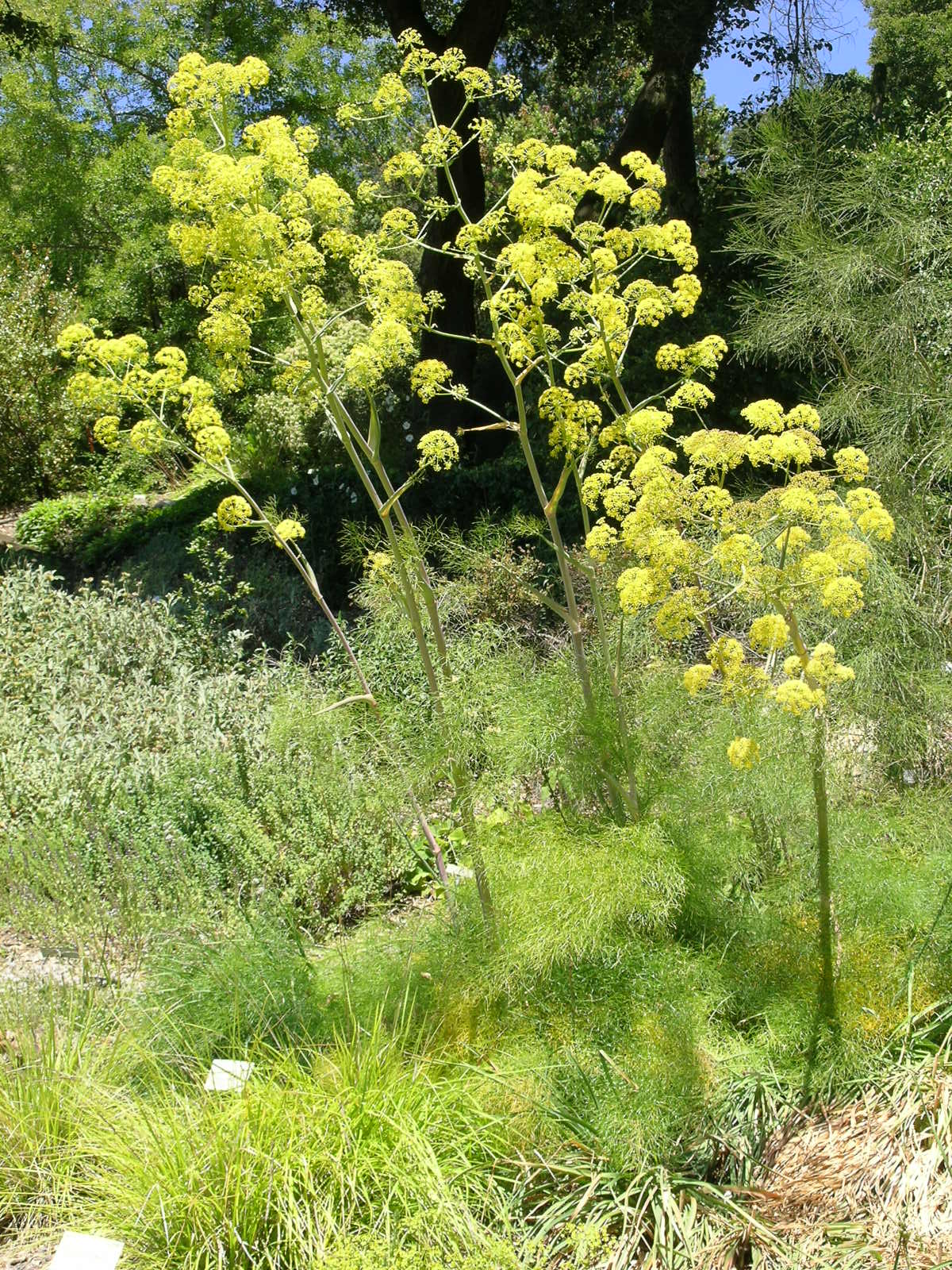
Ferula communis

This plant hosts Anise Swallowtail butterflies at the UC Botanical Garden, or so I have been told. It is closely related to the fennel that they use all over the bay area and beyond, so it is no surprise. What surprised me is the long history of this plant. It is mentioned in Biblical and Roman myths. "Ferula" means rod in Latin, and it is easy to see how a stem of this plant could be broken off and used to stir boiling soup or to help someone walk. It was also used to beat children, I am sorry to say. The sticky resin of Ferula is still used in food and herbal remedies. Have you ever noticed that the inside of the stem of fennel is hollow? This plant has a hollow stem as well. Prometheus hid fire inside and smuggled it to humans. I don't quite see how that would work, seems like it would burn up, but hey, it's a myth! In another myth, Dionysus carries a staff called a thyrsus made with Ferula communis covered with vines and leaves and topped with a pine cone. Some say this is a phallic symbol, and I can see why. Another species of Ferula, Ferula gummosa, is referred to in the Bible as Galbanum. It is mentioned in Exodus as an ingredient in incense. Another sacred plant.

Today is free day at UCBG. Come up, have a look at the Titum Arum that is blooming today, and take a walk around the garden. There are many treasures such as Ferula communis in the Garden.


(host plant)