Sunday, January 16, 2011

Euphorbia perrieri


Here is another Euphorbia. This one is blooming now in the Arid House at the UC Botanical Garden. I love the spines that form several helices. I have read that it is easier for a plant to spiral as it grows, because getting each level exactly in line with the last is difficult. The spines have a different origin in cactus than in euphorbs. Cactus spines are modified leaves. Euphorb spines are modified stipules (tiny bits of green at the base of a leaf. Look for them sometime when you are near a plant.)

The flowers on this plant are also completely different than cactus flowers. These flowers have a green funnel for a flower. Cactus flowers have many petals and are usually brightly colored. Check my post from a couple of days ago for an example.

I think this plant is special because of the umbrella of leaves and the flowers that stick out the top. Different from anything I have seen before.

Saturday, January 15, 2011

Euphorbia echinus


This succulent looks just like a cactus to me, but it isn't. It has those fat stems full of water and needle-like weapons to keep the herbivores away that are common to both the cactus and euphorb families. However the flowers are very different, so they are only distantly related even though they have such a similar form. This is called convergent evolution.

Friday, January 14, 2011

Mammillaria bombycina--Silken pincushion


What an odd name, Mammillaria. These cactus were named for the tubercles that look like nipple, which are not obvious on this specimen. How ever, this particular species has milky latex, adding even more amusement to the mimicry.

The magenta flowers are beautiful, especially against the woolly furriness that portects the plant from the hot summer sun.

More info about this genus here: http://botanicalgarden.berkeley.edu/SOM/SOM-mammilaria.shtml


Blooming now in the Arid House at the UC Botancial Garden.

Wednesday, January 12, 2011

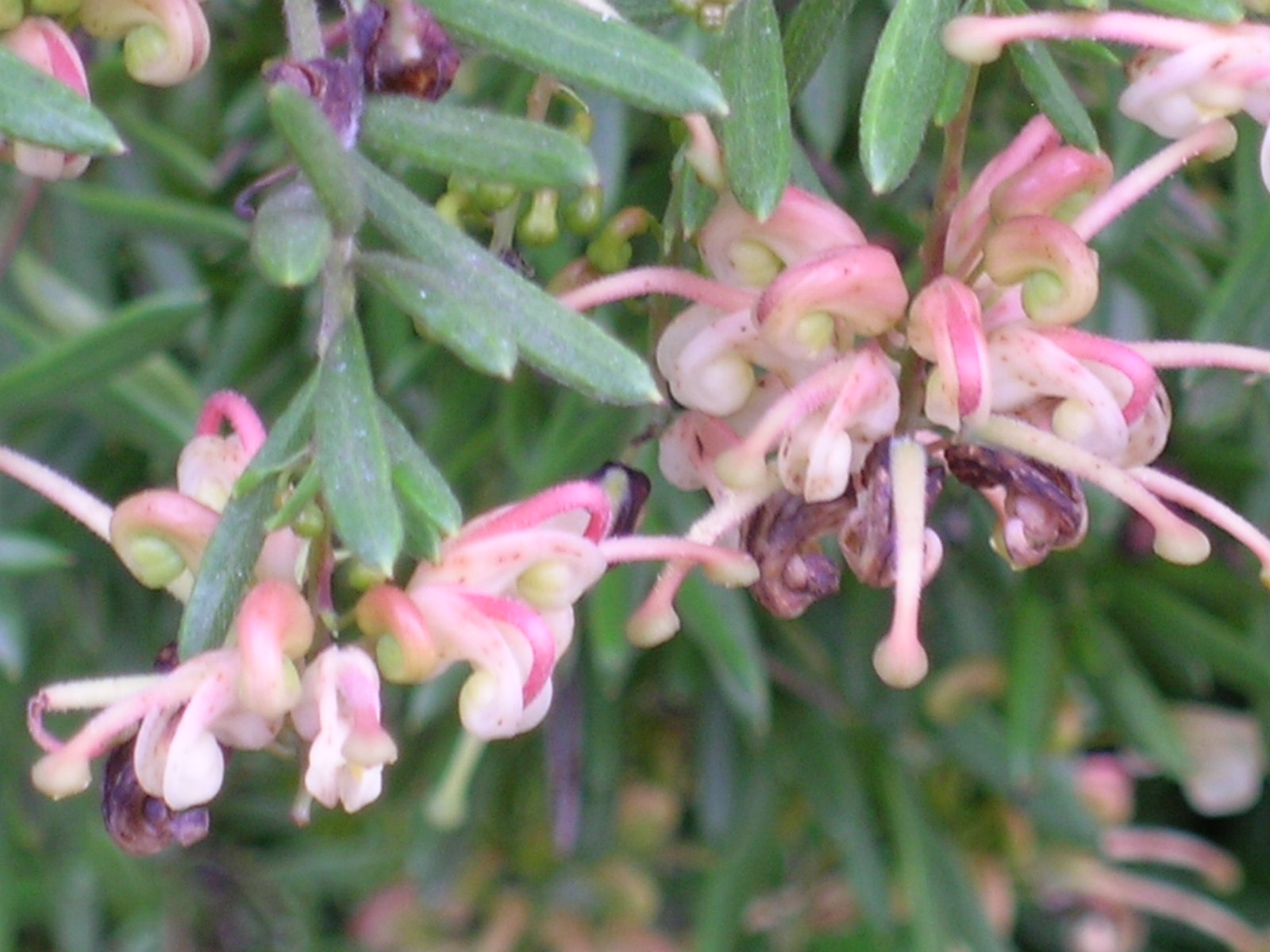
Grevillea lanigera--Woolly Grevillea


The Grevillea is in the Proteaceae family, which is known for its dense clusters of bottle brush flowers. This plant does not have those dense clusters, but the flowers still have the basic family anatomy. If you look closely, it seems to have plenty of pistils, but no stamens. Before the flower opens, the anthers deposit pollen onto the stigmas, which then act as pollen presenters. The anthers remain hidden.

This family occurs naturally in Australia, Africa, South America, India and other places mainly in the southern hemisphere.

Some plants in this family have very sticky flowers that trap insects. Maybe that attracts the birds. Maybe the birds are the real pollinators. But nobody knows.

Tuesday, January 11, 2011

Eucalyptus kybeanensis--Kybean Mallee Ash


This is one of my favorite trees at the UC Botanical Garden. I love the way the trunks twist and the bark shreds and hangs. So melodramatic! I can almost hear the organs...

An Australian marsupial, the koala, has a very close relationship with eucalyptus. In fact, they eat very little else. It is a difficult diet, because it is low in protein, mostly indigestible, and contains many toxins. I can't imagine eating eucalyptus. Too strong!

Any diet has its pros and cons. For the koala, it has little competition for the eucalyptus, no other animals eat it. So it is easy to find enough food without having to fight for it. But they have to put so much energy into dealing with the toxic leaves, they don't have much left over to develop any brain power. Almost half of the skull is filled with cerebrospinal fluid. No other mammals have such a reduced brain.

The digestive tract of the koala is has adapted to handle the strange diet. The hind gut is enlarges and harbors special bacteria to ferment the leaves. The mother passes these bacteria to her offspring when she excretes pap for them to eat. The pap is soft, runny droppings that the mother produces. It is one of the first things koala babies eat when they are being weaned. In fact, they lick it from her anus while they are leaning out of the downward-facing pouch. It seem disgusting, but if they didn't ingest the bacteria from their mom, they wouldn't survive.

Monday, January 10, 2011

Hebe speciosa--Showy Hebe


This beautiful purple-majenta hebe is starting to bloom now at the UC Botanical Garden. The buds are almost as pretty as the flowers, don't miss them!

Hebe, in addition to begin a genus of plants native to New Zealand and South America, is also the Greek Goddess of youth. The plants in this genus are characterized by leaves that are in decussate pairs. Decussate. Good word? It means that the pairs cross each other, so that they are in four rows. In some species the leaves are lined up like soldiers down the stem.

Beautiful flowers in January! Love it!

Sunday, January 9, 2011

Cryptomeria japonica--Japanese Plume Cedar


The Japanese Plume Cedar is odd because it is an evergreen tree with fall color. The needles are green in summer and turn bronze in winter. Does that mean that they turn back to green when the days get longer? I guess so. Seems odd.

The one at the UC Botanical Garden droop and cross each other near the ground, which is unusual in this species. It is supposed to grow as a 60' tall column, as you would expect in a redwood or fir. Maybe this specimen had a hard life in its early years.

This particular tree is the variety elegans, which as dense soft foliage and was introduced from Japan in the mid 1800s. This at the Bot Garden was planted in 1945, as indicated on the lable. Many other varieties are available. Black Dragon has needles that are almost black. Globosa Nana is dome-shaped. Gyokuryu has stiff dark green needles. Knaptonesis foliage is tipped in white. Plus many more; too many to mention.